Monday, January 12, 2026

Buckhorn Dam to be Removed in 2026

Events Calendar

Buckhorn Dam
Buckhorn Dam (photo from the Muskegon River Watershed Assembly)

compiled from several sources.

In Mecosta County, in the village of Paris, Michigan, the deteriorating Buckhorn Dam near the mouth of Buckhorn Creek will be removed in 2026. The Muskegon River Watershed Assembly (MRWA) has announced that funding for restoration of Buckhorn Creek has reached the goal of raising $2.26 million. This amount covers all aspects of the project from pre-planning to completion.

The White Pine multi-use trail passes over the dam, and this will be replaced with an 80-foot bridge. The bridge must be built to standards that will support heavy trail maintenance equipment and emergency vehicles.

Removal of the dam will reconnect the creek with the Muskegon River and restore fish passage up the creek. For years, the DNR has stocked brown and rainbow trout a short way downstream from this point on the Muskegon River. This will allow fish to find cool water refuge in summer months.

The White Pine Trail in that section will be detoured to streets during this process.

The project has taken five years to bring to fruition. The Michigan Department of Natural Resources, the U.S. Fish and Wildlife Service, the Mecosta County Park Commission, and the Friends of the White Pine Trail have collaborated. The dam was originally built to create a mill pond. MRWA director Paul Haan says the pond supplied ice to the nearby fish hatchery. Now the dam is badly deteriorated.

The 2.4 miles of Buckhorn Creek’s cold-water resources will be reconnected to the Muskegon River. The project is expected to be completed by November 2026.


See an article in the Lake County Star


These links are checked on the date of the article. As the article ages, some links may become invalid

Go To www.getoffthecouchnews.blogspot.com for all the news
See Get Off The Couch


Sunday, January 11, 2026

MDARD Requests Feedback on New Invasive Species Listings

Events Calendar

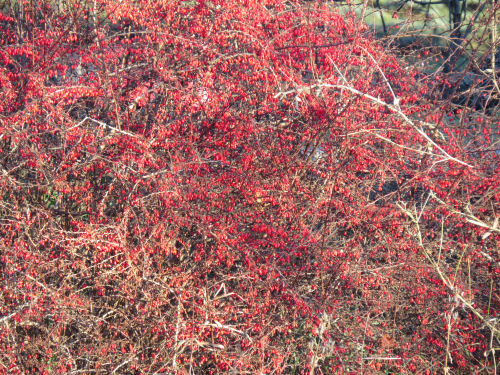
Japanese Barberry
Japanese Barberry (photo by jhy)

a news release of Michigan DNR

The Michigan Department of Agriculture and Rural Development (MDARD) is inviting Michigan stakeholders to provide comments on proposed additions to the invasive plant species regulated in the Natural Resources and Environmental Protection Act (NREPA)(1994) Part 413. MDARD is proposing these additions based on rigorous, scientific Weed Risk Assessments that indicated six invasive plant species could harm Michigan’s environmental, economic, and/or human health. Preventing the spread of invasive species is important to help safeguard the quality of Michigan ecosystems, the strength of Michigan’s economy, and the health of people in Michigan.

A Weed Risk Assessment is available for each of the proposed species:
• Common buckthorn
• Glossy buckthorn
• Callery pear [Bradford pear]
• Japanese barberry
• Water hyacinth
• Water lettuce

If the proposed species are added to the NREPA Part 413 Restricted and Prohibited lists, then it will be illegal to introduce, import, transplant, sell, or intentionally possess them in Michigan. However, a person isn’t considered to be in violation of the rules if they unknowingly have invasive species established on their lands or in waterways.

Please use the online survey to provide comments on the proposed additions to the Restricted and Prohibited lists by 11:59 pm EST on Monday, February 9, 2026. Your input is important and will help ensure that any regulatory changes are well-informed and appropriate. After the public comment period, MDARD will review all feedback and determine if any changes need to be made to this proposal. All changes will be presented to the Michigan Commission of Agriculture and Rural Development.

To read more detail about each plant, please follow the link above and find links to a document on each species.


Take the Survey


These links are checked on the date of the article. As the article ages, some links may become invalid

Go To www.getoffthecouchnews.blogspot.com for all the news
See Get Off The Couch


Saturday, January 10, 2026

Elberta Acquires 16 Acres Lake Frontage for New Park

Events Calendar

alt text
concept drawing of the new park (graphic from Grand Traverse Regional Land Conservancy)

compiled from several sources

The village of Elberta, Michigan, is working to restore the former ferry terminal, train yards, and coal and fuel storage area of Ann Arbor Railroad into a public park and nature preserve. Train service was discontinued in the 1950s and the cross-lake ferry ceased operations in 1982.

The 35-acre property was purchased in 2024 by the Grand Traverse Regional Lake Conservancy from developers who failed to follow through on commercial plans for the site. About half of that land will be incorporated in the new plan. Lake Michigan frontage is 578 feet inside the breakwater, and an additional 3,100 feet of frontage is situated on Betsie Bay.

The purchase is being made by the city with $5.5 million from the Conservancy's donation and $5.3 million coming from the Land and Water Conservation Fund. The village of Elberta applied for this grant in March 2025.

Site remediation will take place from the contamination of the industrial use. Fuels have been stored on the property since the 1890s.

Nine of the sixteen acres will be developed as the new park. The design is still under consideration, and public input will be critical. But it is expected the park will use "habitat-sensitive design" and include parking and restrooms, a paved fishing trail, and a bike trail. The village envisions a Betsie Valley Trailway connection between Frankfort and Elberta beach.


See an article from MLive


These links are checked on the date of the article. As the article ages, some links may become invalid

Go To www.getoffthecouchnews.blogspot.com for all the news
See Get Off The Couch

Friday, January 9, 2026

Do You Need a WAG Bag?

Events Calendar


instructional video- how to use a WAG bag

compiled from multiple sources

For years the recommended method of dealing with human solid waste in the backcountry has been to bury it in a "cathole." However, this method is not suitable in some situations, particularly rocky terrain and deserts. Michigan doesn't have much of either of those, so why should we care?

WAG stands for Waste Alleviation and Gelling. It is basically a double bag that comes packaged with toilet paper, a germicical wipe, and a NASA-developed powder that gels human solid waste and makes it inert and deodorizes it. One bag is large enough to spread between rocks or branches and easily "do your business." You then add the gel, wrap it all up in the smaller, puncture-resistant outer bag, and dispose of it when returning to civilization. Some sources say you can dispose of it in any trash can. Others list recommended drop-off sites. There is debate as to whether the bags will eventually break down in landfills.

Because of a huge increase in backcountry visits, many places in the U.S. West now require their use. Some national parks are providing them free to hikers. The requirement is usually to have one WAG bag per person per day. Mt. Everest (and other peaks) climbers are now required to use them.

On Mt. Whitney, they have been a requirement since 2006.

Some studies show that burying waste doesn't really break it down well. And human waste is likely to contain food-additive chemicals and medicines that can spread to the environment. Pathogens can remain active for over a year.

Is there a place for WAG bags in eastern forests? Probably. Burying waste in the winter if the snow is deep can be problematic. There are environments even in the East that are best characterized as "rocky."

Maybe keeping one in the day pack during the winter would be a sensible idea. Also in the non-frozen seasons for those locations where you just can't find a place to dig a hole (roots, rocks, water too close like in wetland areas).

Cost per set runs about $3.


See a good article on the topic from Atlas and Boots


These links are checked on the date of the article. As the article ages, some links may become invalid

Go To www.getoffthecouchnews.blogspot.com for all the news
See Get Off The Couch


Thursday, January 8, 2026

Hope in the Story from Mentor Marsh

Events Calendar

Phragmites australis
seed heads of Phragmites australis (photo by from a video by the Great Lakes Phragmites Collaborative)

based on a story from Great Lakes Phragmites Collaborative


All too often, you may have seen stands of tall tan grass dominating marshes and crowding out all other plants. Perhaps you wondered if this was a healthy ecosystem, and if something should be done.

If what you have noticed is Phragmites australis (frag-MY-teez) it's a biological disaster. Not many places are working on solutions. But the city of Mentor, Ohio, near Clevland has set an example that could be followed elsewhere.

Mentor Marsh, located in north-eastern Ohio is a success story at removal of the invasive and aggressive Phragmites grass. It forms dense mono-cultures, out-competing native plants.

The marsh covers approximately 800 acres. Beginning in the 1960s, the dumping of waste from a nearby salt production facility increased the salt levels in a tributary stream. Since Phragmites will tolerate salt water, it moved in, quickly displacing native vegetation in Black Brook Creek which flows into the marsh, a former channel of the Grand River.

Phragmites grows so densely packed that the dead stalks become a fire hazard. Since the 1980's there have been twelve major fires at the site, threatening nearby homes. The most recent fire, in 2013, destroyed the boardwalk by which people could access the marsh. When that was rebuilt, workers cleared Phragmites from a ten-foot buffer on each side of the pathway. Native plants quickly returned to this space.

The Cleveland Museum of Natural History manages the marsh. In collaboration with Lake County Soil and Water Conservation district, plans were drawn up to restore the entire site. Over subsequent years, an approved herbicide was both sprayed on the plants, and hand applied. Spraying gives better results with more even application, preventing localized high dosages. Low dosages protected sensitive wildlife. After the plants were dead, marsh buggies were used to reach all areas and remove the Phragmites.

Over 200 million native-plant seeds were then introduced, both by helicopter and by hand.

Biodiversity has returned, both of plants and wildlife. Ongoing monitoring will assure that the Phragmites does not return.

There is a native Phragmites that is not aggressive, but it's seldom found anymore since P. australis has spread throughout the United States.

Watch a 2-minute video of the transformation of Mentor Marsh:


These links are checked on the date of the article. As the article ages, some links may become invalid

Go To www.getoffthecouchnews.blogspot.com for all the news
See Get Off The Couch

Wednesday, January 7, 2026

Where Those Recreation Passport Dollars Go

Events Calendar

diggins hill sensory playground
concept drawing of Diggins Hill Sensory playground in Cadillac, one of the funded projects (from City of Cadillac)

a news release of Michigan DNR

The Recreation Passport replaced the DNR’s traditional annual motor vehicle permit for state park access in 2010 with a purchase program tied to the renewal of license plate registrations. The Recreation Passport is a $14 annual pass required for access to 103 state parks and recreation areas, more than 140 state forest campgrounds, Michigan historic sites, hundreds of boating access sites and thousands of miles of trails. The goal is boosting visitation and funding for Michigan state parks. The income also supports operations, infrastructure and historic and cultural assets in Michigan’s state parks and recreation system. Approximately 97% of funding for recreation operations and maintenance is generated from user fees including the Passport, and 11% of this comes from oil and gas revenue.

Ten percent of the proceeds from Recreation Passport sales are granted to communities across the state for development and improvement of local public recreation facilities.

Counties where funded grant projects have been approved for 2025 include Allegan, Barry, Branch, Clinton, Genesee, Ingham, Leelanau, Macomb, Muskegon, St. Clair and Wexford, five of which are in west Michigan.

Selected projects were scored and selected from a field of 57 grant applications, and a total of $22.3 million statewide has been awarded.

West Michigan recipients are:
 • Barry County- Charlton Park Boating Area Improvements- $150,000
 • Wexford County- Diggins Hill Sensory Playground- $127,800
 • Allegan County, City of Saugatuck- Village Square Park Improvements- $150,000
 • Muskegon County, Fruitland Township- Accessible Pathways for Nestrom Park- $82,300
 • Leelanau County, Suttons Bay Township- Herman Park Playground Project- $105,000

“The Recreation Passport remains one of the best values in outdoor recreation anywhere in the United States,” said DNR Director Scott Bowen. “Beyond providing annual public access to dozens of state parks, trailheads, state forest campgrounds and boating access sites, 10% of the proceeds from each $14 Recreation Passport help fund state park improvements and maintenance and grants to communities for additional local park improvement projects.”


See full list of 2025 Recreation Passport Grant recipients


These links are checked on the date of the article. As the article ages, some links may become invalid

Go To www.getoffthecouchnews.blogspot.com for all the news
See Get Off The Couch


Tuesday, January 6, 2026

Asylum Lake Preserve Master Plan

Events Calendar

Asylum Lake
Asylum Lake Nature Preserve (photo from Western Michigan University)

from the Asylum Lake Preserve website

Asylum Lake Preserve is a 274-acre parcel of land that is owned by Western Michigan University, Kalamazoo, Michigan. The land is used for university research and is preserved as a passive-use recreation area under an agreement between the city of Kalamazoo and WMU. Asylum Lake's preservation was ensured as a condition of the development of the College of Engineering on Parkview Avenue. The Asylum Lake Preserve is located at the corner of Drake Road and Parkview Avenue in Kalamazoo, Michigan.

On the property are two lakes in addition to prairie and forest ecosystems. Currently, about three miles of trail with moderate elevation changes exist, but the Master Plan calls for additional trails, including those for persons with disabilities, and several paved access routes for emergency vehicles. The existing trails are a mixture of natural surface and pavement. There are several observation/fishing platforms along the shore of the larger lake.

As a preserve, the primary goal is to maintain habitat for native plants and wildlife, but quiet recreation is welcome. Dogs must be leashed. A volunteer group supports the preserve.

Currently the plan is in Phase II which involves improvements to the existing trails.


See map of the Master Plan for Asylum Lake
Download the Asylum Lake brochure


These links are checked on the date of the article. As the article ages, some links may become invalid

Go To www.getoffthecouchnews.blogspot.com for all the news
See Get Off The Couch


Monday, January 5, 2026

Paddling Film Festival February 27

Events Calendar

kayak
paddling (photo from Quiet Adventure Society)

from the Quiet Adventure Society

In connection with the 2026 Quiet Adventure Symposium, there will be a a night of film to kick off the event. A selection of this year's 2026 Paddling Film Festival World Tour is brought to you by Drift and Roam Events and Quiet Adventure Society. The Film Festival will be at E. L. Hannah Community Center: Albert A. White Auditorium, 819 Abbot Rd, East Lansing, Michigan, 48823, on Fri, Feb 27, 2026 from 7-10 pm.

This event will feature 6 Films including the award winners for Best Canoeing Film, Best Instructional Film, Best Short Film, Best Documentary, and a Special Jury Mention.

General Admission: 320 seats on the main floor and 155 seats in the balcony. Seats are first come first serve at doors. Advance discounted tickets avalible thru 1/31 for $8. Advanced tickets available starting 2/1 and running thru 2/26 $10. Day of tickets 2/27 at Door $15(Cash/Card). Children (10 and under) FREE with adult ticket. Verification of age to be provided if asked, at the discretion of venue staff.

Proceeds from this event will equally go to support the misisons of Drift and Roam Events and Quiet Adventures Society as oulined below.

The day-long Quiet Adventure Symposium will be February 28, 2026 at the Farm Bureau Pavilion at MSU, Lansing, Michigan.

Drift and Roam, LLC ’s goal is to connect people of all backgrounds with the joy of paddling and the beauty of the natural world. Through inclusive programs, accessible adventures, and a welcoming community, we inspire exploration, stewardship, and a lifelong love for the outdoors. The first step in this is building a following by hosting engaging events in the Metro Detroit area such as paddling basics clinics, safety techniques, and competitive races.

The Quiet Aventure Society seeks to educate the public and encourage participation in non-motorized, outdoor recreation; to promote public concern and support environmental stewardship and conservation of natural resources of the Great Lakes region; to plan and execute annual and special events for any or all of the purposes listed. They have hosted the annual Quiet Adventure Symposium (formerly Quiet Water Symposium) since 1996.


Buy tickets


These links are checked on the date of the article. As the article ages, some links may become invalid

Go To www.getoffthecouchnews.blogspot.com for all the news
See Get Off The Couch


Sunday, January 4, 2026

Tribal Purchase of Land Will Not Impact Boardman Lake Loop Trail

Events Calendar

Boardman Lake Loop Trail bridge
Boardman River Bridge, Loop Trail (photo from TART)

compiled from several sources

What has been the Boardman Lake Campus of Northwestern Michigan College will be sold to the Grand Traverse Band of Ottawa and Chippewa. The purchase price is $27 million.

The college is moving all its facilities to the main campus in downtown Traverse City. Money from this sale will be used for capital improvements at the downtown location.

Of concern to many local recreational users is the fact that the Boardman Lake Loop Trail passes through that property. The tribe has stated that the trail will not be impacted in any way. They have also signed an agreement that no gaming activities will be conducted on the property. There are already a number of office buildings on the land, and the intent is to use them for centralized government administration.

The Boardman Lake Loop Trail was completed in 2022, and is four miles long, encircling Boardman Lake. It includes urban and wooded sections and a spectacular, sinuous bridge over the Boardman River. Approximately one quarter mile of trail will now be on tribal land. The trail itself is owned by the City of Traverse City, in partnership with Grand Traverse County and Garfield Township. TART Trails collaborates with these entities to support the development and maintenance of the trail.


See map of the Boardman Lake Loop Trail


These links are checked on the date of the article. As the article ages, some links may become invalid

Go To www.getoffthecouchnews.blogspot.com for all the news
See Get Off The Couch


Saturday, January 3, 2026

Improvements to Vasa Trailhead

Events Calendar

VASA trail sign
VASA trail sign (photo from Grand Traverse County)

from VASA Trails

We are excited to announce that GTC Parks and Recreation has been awarded a $400,000 grant for improvements to the Vasa Trailhead Park from the Michigan Natural Resources Trust Fund.

This award, combined with matching funds from TART Trails and the County will bring needed reconstruction of the stormwater retention system, increased and improved parking, connecting pathways between the warming hut and trails, and more.

“The Vasa Trail network is one of the most beloved recreational resources in our area. A passionate group of community members had a vision in the late 1980s for a world-class trail system. Their dream came true and now we have the opportunity to redevelop the Vasa Trailhead Park to match that vision. We are grateful to the Michigan Natural Resources Trust Fund Board for helping make this happen,” said John Chase, Director of Parks and Facilities for Grand Traverse County.

Design and engineering for the project have already been completed. Funds are anticipated to become available from the State of Michigan in 2026 with a construction schedule to follow.

The Vasa Pathway is named for the famous Vasaloppet ski race in Sweeden, the world's oldest and largest cross-country ski event, established in 1922. In 1977, the Grand Traverse Vasa held it's first ski race. The trail system consists of a series of four four-season loops located east of Traverse City, Michigan. The longest loop is 25 kilometers, and the shortest is three. The trail hosts the annual Iceman Cometh bicycle race, and the North American Vasa cross-country ski race.


See map of Vasa Pathway


These links are checked on the date of the article. As the article ages, some links may become invalid

Go To www.getoffthecouchnews.blogspot.com for all the news
See Get Off The Couch


Friday, January 2, 2026

MOWA Invites Nominations for 2026 Clean Waterways Award

Events Calendar

recipient of Clean Waterways award 2025
Kenneth Kornheiser receives the 2025 award on behalf of Kalamazoo River Watershed Council from MOWA board member Jeff Nedwick (photo from MOWA)

a news release of Michigan Outdoor Writers Association

The Michigan Outdoor Writers Associations (MOWA), in partnership with Enbridge, is accepting nominations for the 2026 MOWA Clean Waterways Award. The Clean Waterways Award recognizes and rewards organizations who demonstrate continuous, voluntary efforts to protect, preserve, and enhance the lakes, rivers, and streams of Michigan.

Threats to Michigan’s waterways are on the rise and it’s more important than ever to protect our most vital and treasured assets. While stewardship of our waterways is everyone’s responsibility, MOWA is specifically seeking to reward local or regional organizations operating within the state of Michigan for their voluntary stewardship efforts.

Last year's recipient was Kalamazoo River Watershed Council. The KRWC played a critical role in the cleanup and restoration of the Kalamazoo River after the July 2010 oil spill that released up to a million gallons of tar-sands crude oil into Talmadge Creek – a small tributary to the Kalamazoo River near Marshall, MI – which resulted in the contamination of a 30-mile stretch of the Kalamazoo River. The Kalamazoo River Watershed Council, an Assisting Agency under the Unified Command led by U.S. EPA and Enbridge, closely monitored the spill response and contributed numerous technical suggestions based on their experience and familiarity with the river and floodplain ecosystems. They were also involved in outreach activities, including public talks and presentations to schools and community groups.

About MOWA
Founded in 1944, MOWA is a non-profit organization comprised of outdoor communicators with a passion for communicating about nature, the environment, and outdoor recreation. MOWA’s members communicate on various outdoor subjects including hunting, fishing, skiing, hiking, snowmobiling, backpacking, the environment, education, trapping, travel, humor, natural resources, conservation, ecology, birding, boating, canoeing, kayaking, shooting sports and more.


Detailed information about the award can be found by visiting the Clean Waterways Award section of the Michigan Outdoor Writers Association website. Please contact Jeff Nedwick for additional information or questions: jeffsoutdrs@gmail.com


These links are checked on the date of the article. As the article ages, some links may become invalid

Go To www.getoffthecouchnews.blogspot.com for all the news
See Get Off The Couch


Thursday, January 1, 2026

Traverse City Adopts Complete Streets Policy

Events Calendar

city bicycle lane
Traverse City downtown bike lane (photo from TART )

based on the Traverse City policy statement

This month, December 2025, Traverse City, Michigan, passed a new policy that sets the goal for all city streets to be "complete," which means they will be designed not only for motor vehicles, but will accommodate walkers, cyclists, and public transportation, all with ADA compliance.

"Traverse City aims to provide a complete and connected transportation system that enhances safety, health, and quality of life for all users." The vision is to create a network that offers safe and efficient corridors for travel for all modes of transportation, and to set metrics by which to evaluate progress toward that goal.

The policy sets city-wide standards. However priority will be given to "historically underinvested and underserved" neighborhoods. One percent of the annual city budget will be earmarked for this purpose, and all new construction, renovation, re-paving, etc must meet the new standards unless a clear exception is granted for a good reason. Exception applications must be open for public comment for 30 days.

The following performance measures will be assessed each year, including but not limited to:
• Miles of sidewalks with pedestrian-scale lighting
• Winter maintenance levels for all users
• Miles of missing sidewalks completed
• Ridership of local transit agencies
• Pedestrian and bicycle counts on streets
• Improvements in ADA accessibility and curb ramps
• Miles of completed Complete Streets

An article by 9 and 10 News cites the first example of the policy's success. Eighth Street was recently reconstructed, and it meets all the standards. Residents are reported to be extremely happy. There is also a picture showing the newly adapted street and sidewalk lanes.


See 9 and 10 News article


These links are checked on the date of the article. As the article ages, some links may become invalid

Go To www.getoffthecouchnews.blogspot.com for all the news
See Get Off The Couch